Recollected Words of Abraham Lincoln by Don E. Fehrenbacher & Virginia Fehrenbacher
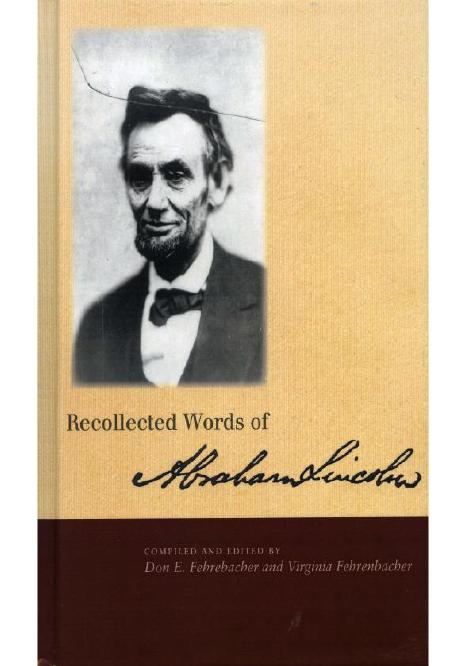
Author:Don E. Fehrenbacher & Virginia Fehrenbacher [Fehrenbacher, Don E.]
Language: eng
Format: epub, pdf
Publisher: Stanford University Press
Published: 1996-11-01T06:00:00+00:00
AGNES HARRISON MACDONELL
English girl who attended a White House reception in February 1863 and wrote home about it to her parents.306
1. Responding to her statement that the people in her family were with him “in heart and soul, especially since the 1st of January”:
I am very glad to hear it, very glad, though I may not know them personally. That is one of the evils of being so far apart. We have a good deal of salt water between us. When you feel kindly towards us we cannot, unfortunately, be always aware of it. But it cuts both ways. When you, in England, are cross with us, we don’t feel it quite so badly. —Macdonell, 568. {A}
2. Lincoln also said to her that:
he thought there were three parties in England: an aristocratic party, which will not be sorry to see the Republic break up; a class allied to the South through trade relations; and a third, larger, or if not larger, of more import, which sympathizes warmly with the cause of the North. —568. {B}
ALLAN B. MAGRUDER
A Virginian who, on the eve of the Civil War, was practicing law in Washington, D.C.
1. In early April 1861, Magruder was enlisted by the President and the Secretary of State as a messenger to George W. Summers, a leading Virginia unionist. Lincoln said of Summers:
that he thought very highly of him as a prudent and wise man; that he had great confidence in him; that indeed he had confidence in all those Virginians; that although they might differ from him about secession, he believed they were men who could be depended on in any matter in which they pledged their honor; and that when they gave their word, they would always keep it.
He then continued: Tell Mr. Summers I want to see him at once; for there is no time to be lost. What is to be done must be done quickly.... This is Tuesday; I will give him three days. Let him come by Friday next.... If Mr. Summers cannot come himself, let him send some friend of his, some Union man in the convention in whom he has confidence and who can confer freely with me. —Magruder, 439 (1875). {C}
Instead of Summers, it was John B. Baldwin (q.v.) who went to confer with Lincoln.
WILLIAM WYNDHAM MALET (1804—1885)
An English clergyman who visited the United States on family business in 1862.
1. Lincoln talked with Malet for about twenty minutes on May 31 and, among other things, told him that:
they used hard, unbituminous coal in the United States navy, giving great force of fire without the slightest smoke, so that the approach of their men-of-war is not seen over the horizon or in rivers. —Malet, 17 (1863). {C}
2. In the same conversation, Lincoln lamented the war and said that:
if he could have foreseen it, he would not have accepted the office of president. —17. (C)
ROBERT MALLORY (1815—1885)
Unionist congressman from Kentucky throughout the Civil War. He opposed emancipation and Lincoln’s re-election.
1. Mallory, together with Senator Lazarus W.
Download
Recollected Words of Abraham Lincoln by Don E. Fehrenbacher & Virginia Fehrenbacher.pdf
This site does not store any files on its server. We only index and link to content provided by other sites. Please contact the content providers to delete copyright contents if any and email us, we'll remove relevant links or contents immediately.
| Africa | Americas |
| Arctic & Antarctica | Asia |
| Australia & Oceania | Europe |
| Middle East | Russia |
| United States | World |
| Ancient Civilizations | Military |
| Historical Study & Educational Resources |
Cat's cradle by Kurt Vonnegut(15556)
Pimp by Iceberg Slim(14796)
4 3 2 1: A Novel by Paul Auster(12612)
Underground: A Human History of the Worlds Beneath Our Feet by Will Hunt(12232)
The Radium Girls by Kate Moore(12182)
Wiseguy by Nicholas Pileggi(5935)
The Fire Next Time by James Baldwin(5585)
Perfect Rhythm by Jae(5542)
American History Stories, Volume III (Yesterday's Classics) by Pratt Mara L(5387)
Paper Towns by Green John(5327)
Pale Blue Dot by Carl Sagan(5155)
A Higher Loyalty: Truth, Lies, and Leadership by James Comey(5089)
The Doomsday Machine by Daniel Ellsberg(4621)
The Mayflower and the Pilgrims' New World by Nathaniel Philbrick(4607)
Killers of the Flower Moon: The Osage Murders and the Birth of the FBI by David Grann(4548)
The Sympathizer by Viet Thanh Nguyen(4510)
Too Much and Not the Mood by Durga Chew-Bose(4456)
The Borden Murders by Sarah Miller(4449)
Sticky Fingers by Joe Hagan(4318)
